The Same Story
Every piece of mathematics has a story behind it. So does every work of art. Sometimes they tell the same story. How could this be so? Do mathematics and art come from the same place in the human brain? Do mathematics and art have a common origin in antiquity?
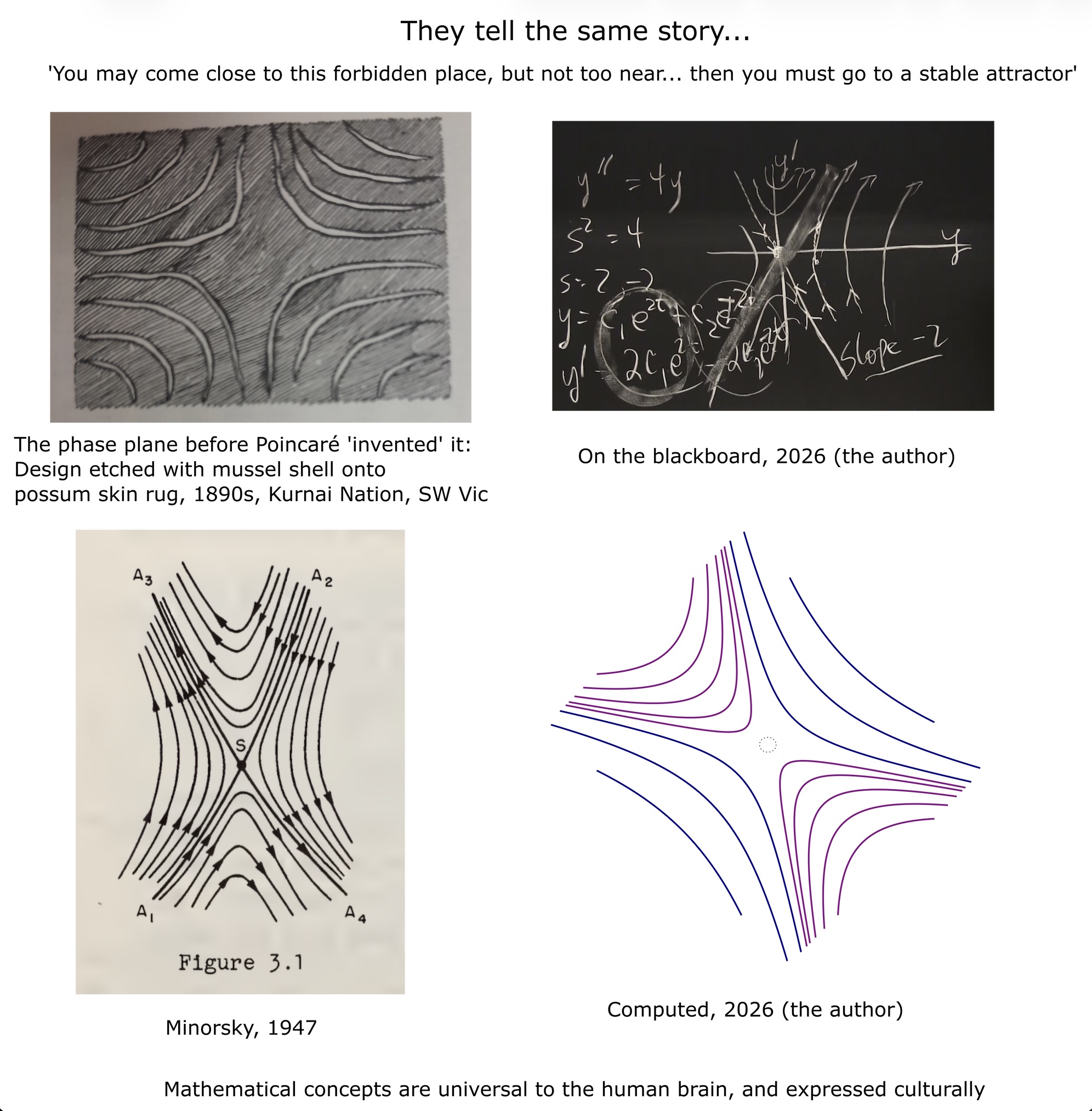
In this collage I have juxtaposed a piece of art from the GunaiKurnai nation, photographed in the 1890s, against mathematical phase planes sketched and computed in the 20th and 21stcenturies.
Phase plane (or phase diagram) analysis is typically taught in first or second year mathematics or mathematical physics courses on qualitative analysis of second-order ordinary differential equations that model a time dependent system. The curves in thediagrams are known as trajectories, phase paths, or integral curves. Despite the non-appearance of the time variable in the phase plane, we can read off the story of the motion. Students, in exams, are often asked to sketch the complete phase portrait of a given planar, autonomous dynamical system and describe the motions and equilibria in words. They must tell the story!
The field of qualitative analysis of dynamical systems was invented by Henri Poincaré in the 1890s, who understood that you could tell the story of a dynamical system even better without ‘solving’ it. Poincaré never actually sketched a phase portrait though. Other mathematicians did so in the 20th century, and by 1947 the method was appearing in textbooks.
The story behind the (partial) phase planes in this collage is about an unstable fixed point, or equilibrium point. It is a forbidden destination. Trajectories must always swing away from it, towards another safe, stable destination.
The GunaiKurnai story, etched onto a possum-skin rug, is essentially the same story. It is permitted to be shared by the cultural authority of the GunaiKurnai Elders. ‘The Nargun cave is a sacred women’s initiation and ceremonial place, forbidden to all others. On any path to the cave, men and uninitiated children will be chased away, back to the safety of the home campfire’.
Both stories serve the same purpose of sharing, and passing down generations, important cultural information that humans need to bind their societies together and advance knowledge. We should not be surprised that they are expressed the same way.
Humans all have the same mathematical/artistic brain. A widely held belief, often deeply internalized, is that mathematics is primarily of European provenance, thence gifted to the curriculums of the whole world as the highest form of knowledge. This belief is not true, of course. For how could one group/race of humans be intrinsically capable of mathematical thought, or have an inherent ability to do mathematics, but other groups/races not?
All societies that we know of practise, or practised, mathematics and art. Teasing out these stories is a never-ending source of wonder and delight to me! Mathematics really does unite us as humans!